Root Cause Analysis Software for Manufacturing Plants

When the same conveyor alarm returns after a repair, review the earlier work and investigate what is causing the fault. MaintBoard helps maintenance teams keep findings with the equipment history and track the corrective work that follows.
  • Compare earlier stoppages, repair notes, and parts replaced.
  • Document the findings from Fishbone Analysis and 5 Whys.
  • Assign corrective work and review whether the fault returns.
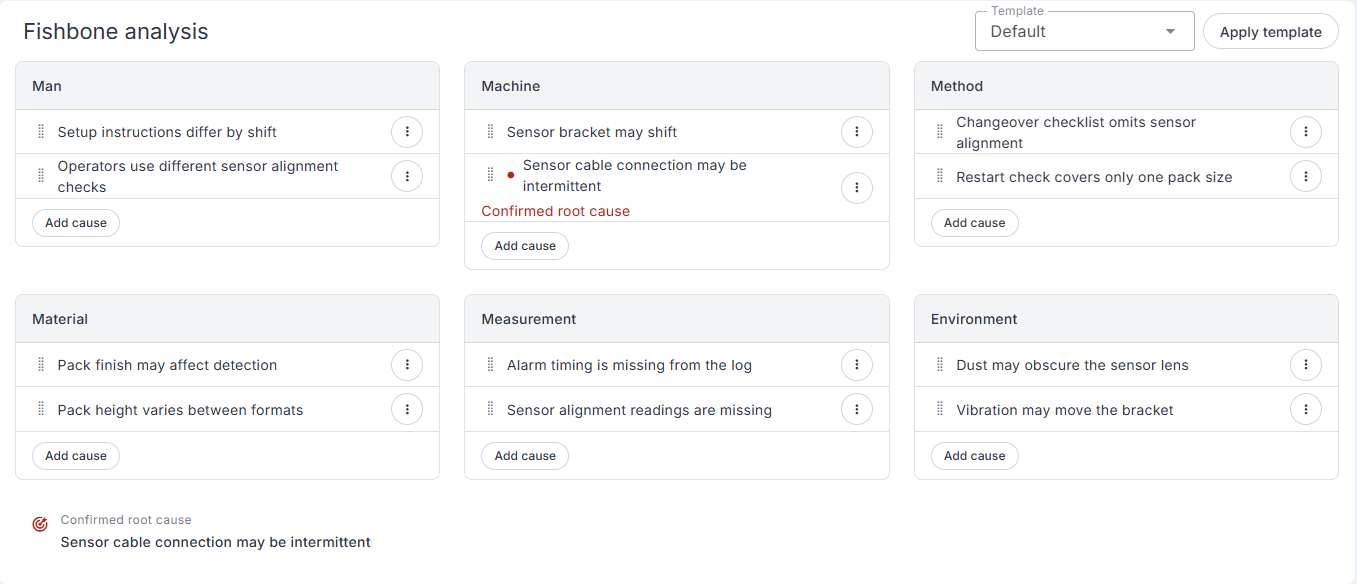
MaintBoard Fishbone Analysis showing possible causes of a packaging conveyor stoppage and the confirmed root cause under Method.

Why does the fault keep coming back?

A packaging conveyor repeatedly stops on a product detection alarm after changeover. The sensor was replaced last week. The team needs to compare the failed runs and check how the setup changed.

Alarm codes give limited detail

A product detection alarm gives the team a starting point for the investigation.

Previous repairs need review

The earlier sensor replacement is part of the history the team needs to check when the alarm returns.

The fault can return after restart

Production may resume while the team still needs to investigate why the conveyor keeps stopping.

How to investigate a recurring conveyor fault

In this illustrative investigation, the team uses Fishbone Analysis to decide what to test, then follows one finding with 5 Whys.

Step 1

Define the problem

Record the machine, alarm, changeover timing, and packs involved. Review the prior breakdowns. Explore breakdown maintenance .

Step 2

Map possible causes with Fishbone Analysis

Compare equipment (sensor bracket), method (setup checks), material (pack finish), people (shift instructions), measurement (alarm records), and environment (dust or vibration). Test the causes that fit the evidence.

Step 3

Use 5 Whys on the confirmed finding

Why did the conveyor stop? The sensor missed a pack. Why did it miss the pack? It was out of alignment. Why was it out of alignment? The guide rail contacted the bracket during adjustment. Why could it contact the bracket? The bracket sat within the rail's adjustment range. Why was that clearance missed? The relocation check covered the current pack setting only. Verify each link with observations or records.

What to keep with the investigation

Evidence and findings

Record what the team checked and what the checks showed.

Corrective work

Assign a work order to review bracket clearance across the pack range and give the setup-check update an owner. Explore corrective work orders .

Verification

Agree what to observe during the next changeovers and record whether the alarm recurs.

Which problems warrant a closer look?

Repeat pump seal leaks

Compare prior repairs and operating conditions.

Repeated conveyor stops

Look for a pattern by product or changeover.

Press faults across shifts

Compare alarm details and the dies in use.

What to review after the corrective work

Check which actions are complete and which still need an owner or due date.

Completion

Review the same alarm under comparable operating conditions.

Recurrence

Continue the investigation if the fault returns or the expected change is absent.

New evidence

Root Cause Analysis FAQs

What is the difference between Fishbone Analysis and 5 Whys?
A fishbone diagram groups possible causes. 5 Whys uses successive questions to trace a finding through the events and conditions that led to it.
Do we have to ask exactly five questions?
Ask as many as the evidence warrants. Follow each answer with a check and investigate multiple paths when the evidence points to them.
How do we verify a corrective action?
Agree on what to observe, the operating conditions to compare, and when to review the results. Record the outcome with the investigation.

Bring a fault your plant keeps repairing

We'll walk through the breakdown history, document what your investigation found, and show how to track the corrective work in MaintBoard.